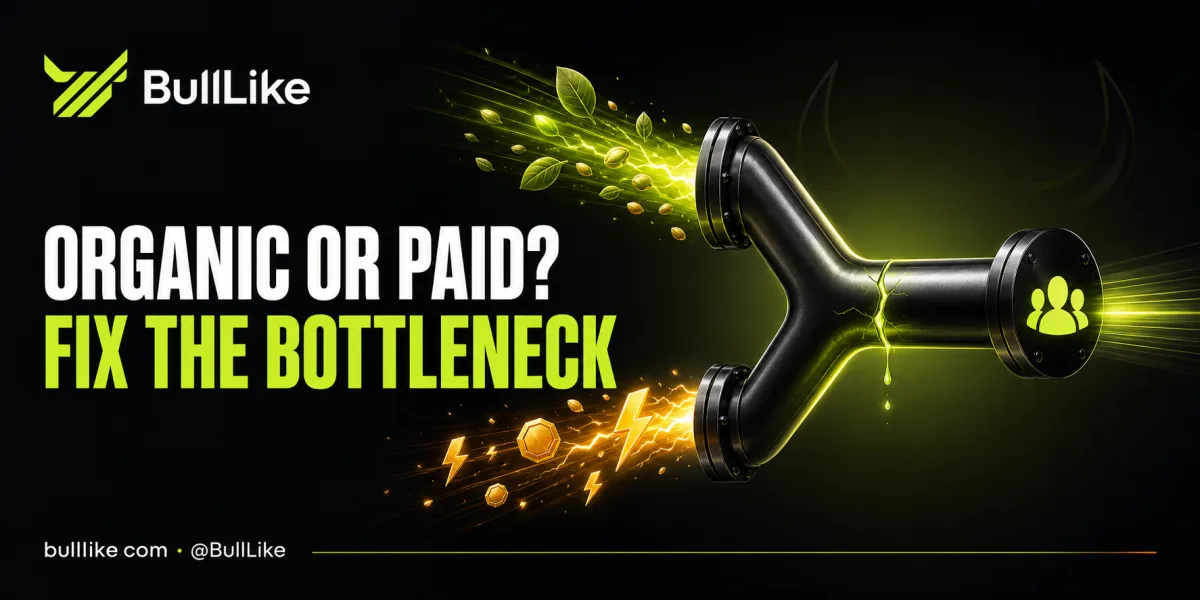
Organic Distribution vs Paid Amplification: When to Use Each
Organic distribution and paid amplification solve different creator problems. Organic publishing tests whether a message earns attention and return behavior within a platform’s natural surfaces. Paid amplification buys controlled distribution toward an objective. Neither fixes a weak promise, broken profile, poor landing page, or unreliable measurement.
The practical decision is not “organic or paid forever.” It is “which bottleneck limits the next outcome, and is the funnel ready to receive more volume?” Use organic evidence to reduce creative uncertainty, then amplify when the content, destination, and tracking can support a larger test.
What can organic distribution teach that paid cannot?
Organic response reveals how existing and discovered audiences interact without a media budget attached to each impression. It can surface topic fit, community language, recurring questions, retention patterns, and creator-audience trust. It is also influenced by channel history, platform surfaces, timing, and audience composition.
Organic is not free. Production, editing, publishing, moderation, and analysis consume capacity. Treat those costs as an investment in assets and learning.
A weak organic result does not prove a concept can never work with paid targeting. It does mean the team should explain why paid distribution would change the audience or context instead of simply adding spend.
What does paid amplification do well?
Paid media can expand reach, target defined groups, control pacing, and optimize toward available objectives. Meta distinguishes objectives such as Awareness and Traffic; the selected objective helps the system pursue a specific type of result. Creative, audience, destination, and measurement still shape the outcome.
Paid is useful when organic evidence is promising but exposure is limited, when a launch needs a defined reach window, or when a creator needs a structured audience test. It can also validate whether the message works beyond a loyal core.
Paid views or clicks must be labeled in reporting. They are not proof of organic recommendation or unpaid fandom.
Which bottleneck should be fixed before buying more reach?
Map the funnel: impressions or reach, starts, sustained watch, profile visits, follows, link clicks, engaged sessions, and meaningful action. Locate the sharpest controllable drop.
If early attention is weak, fix packaging and hook. If watch is strong but profile visits are low, build a creator bridge. If visits are high but follows are weak, fix the profile promise. If clicks are healthy but the website loses users, repair the destination. Paid amplification above an unresolved leak sends more people into the same problem.
Confirm operational capacity. More leads are not helpful when response time, inventory, or onboarding fails.
How do you decide whether a post is ready to amplify?
Use a readiness gate rather than “this post got the most likes.” The content should match a defined audience job, show healthy attention for its format, connect to a clear profile or destination, avoid unsupported claims, and have rights cleared for paid use.
| Readiness area | Evidence |
|---|---|
| Message | Hook and payoff match |
| Audience | Organic responders fit the intended group |
| Attention | Retention is healthy in context |
| Destination | Profile or page converts and loads well |
| Measurement | Objective, tracking, and baseline are ready |
| Rights | Music, footage, talent, and claims are cleared |
| Capacity | Team can handle the downstream response |
Do not boost content solely because a platform suggests it. The creator owns the business decision.
When should organic content be improved first?
Improve organic first when the value proposition is unclear, content pillars are unstable, retention repeatedly fails before proof, the profile is inconsistent, or the creator cannot yet produce the format sustainably. These are learning and execution problems, not distribution shortages.
Run matched experiments on hook, structure, topic, and CTA. Build a small library of repeatable winners, not one viral exception. YouTube’s current CTR guidance emphasizes context: traffic source and audience changes can shift rates, and a metric should not be read in isolation.
Do not wait for “perfect organic” before every ad. Use enough evidence to identify the uncertainty paid is meant to resolve.
When is paid amplification a sensible next step?
Amplify when content has a clear role, the audience hypothesis is defined, the next action works, and the team needs more qualified exposure or a faster controlled test. Set a budget cap and stop rule before launch.
Start with a pilot. Compare creative variations without changing audience, destination, and optimization simultaneously. Keep frequency and downstream quality visible. A lower cost per click is not a win if sessions are unengaged or leads are unqualified.
Scale in steps after results repeat. Marginal performance can change as the audience broadens.
How should organic and paid results be reported?
Separate source, spend, impressions, reach, views, watch behavior, profile actions, clicks, sessions, and conversions. Use platform IDs and campaign parameters so a creator can trace results to the asset and destination.
Do not subtract paid views from total public views and label the remainder organic unless the platform definition supports that calculation. Native reports, public counts, and external analytics may use different methods.
State correlation limits. If organic, paid, partner, and ordered activity ran together, do not assign all growth to one source without a controlled design.
Where do ordered visibility and social proof fit?
Ordered delivery is an operational source distinct from both native organic distribution and ad-platform paid amplification. It may support presentation under the service scope, but it does not establish verified customers, organic interest, or recommendation performance.
Store order IDs, quantity, status, cost, and terms separately. In reports to clients, sponsors, or partners, disclose sources according to the relationship and avoid mislabeling.
The rest of the proof stack should include real content quality, permissioned testimonials, transparent process, policies, and measurable audience behavior.
How can a clean amplification test be designed?
Choose one or two organic assets that solve the same audience job. Define the paid objective, audience, budget, period, destination, UTM, primary metric, and guardrails. Hold major settings stable long enough to interpret.
Create a comparison group when practical, such as matched organic-only content or geographic/time controls. Recognize that perfect incrementality testing may be unavailable for small creators; label results directional rather than causal.
Review creative and funnel metrics together. Paid exposure can reveal that an asset was strong only for loyal followers, which is valuable learning rather than a failed campaign.
What should trigger a stop instead of more spend?
- Tracking or destination failure
- Policy, rights, or claim uncertainty
- Rapidly falling downstream quality
- Frequency rising without incremental action
- Negative feedback beyond the guardrail
- Team capacity or inventory constraint
- Creative promise mismatched to the landing page
- No decision rule or owner
- Budget being increased to recover sunk cost
- Results reported from the wrong objective or metric
Stopping protects learning. Preserve the data, fix the bottleneck, and relaunch only with a new hypothesis.
A balanced 30-day operating loop
Week one mines organic evidence and audits the funnel. Week two produces matched variations and confirms the profile or landing page. Week three runs a capped paid pilot with clean tracking. Week four compares source-level quality, records the decision, and allocates the next cycle.
Keep an organic publishing cadence during the pilot so the profile remains credible and new visitors can see recurring value. Paid should amplify a system, not a single isolated asset.
FAQ
Should a creator wait for a viral organic post before using ads?
No. Wait for a clear audience, message, destination, and measurement plan. A viral post is not required and can be an outlier.
Does paid amplification hurt future organic reach?
Do not assume a universal causal effect. Separate sources, inspect content and audience context, and use platform reporting.
Is the lowest cost per click the best result?
Not if visitors fail to engage or convert. Judge the objective and downstream quality together.
Can ordered views be combined with paid views?
They should be recorded as separate operational sources. Combining them removes decision value and can mislead stakeholders.
When should spend be scaled?
After the result repeats, tracking is reliable, guardrails hold, and the team can handle the next volume level.