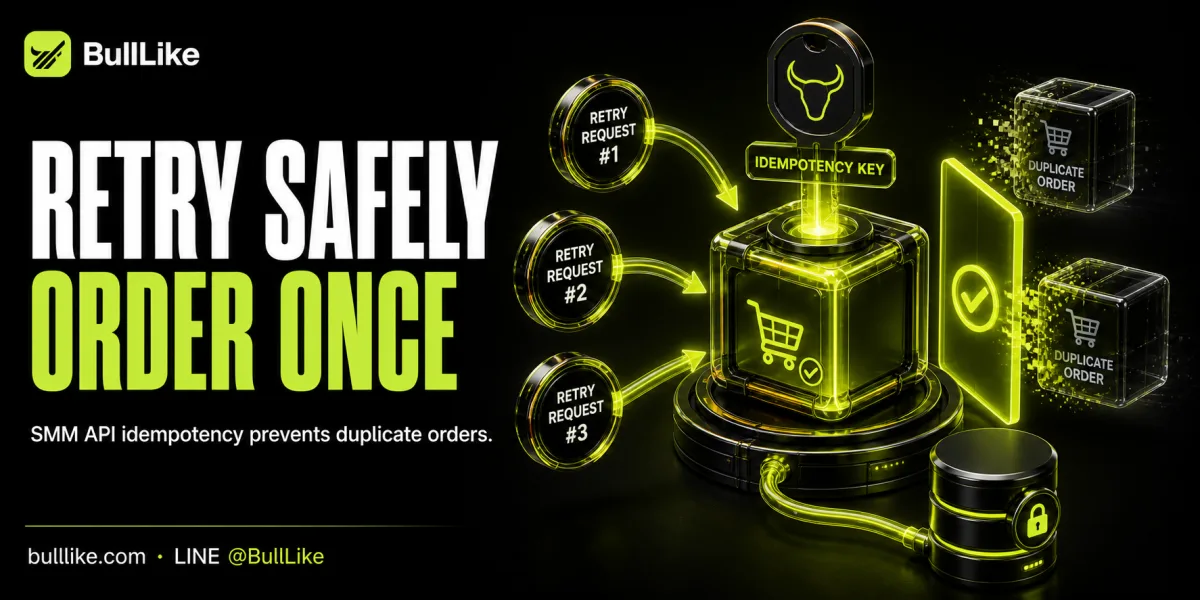
SMM API Idempotency: Prevent Duplicate Orders During Retries
An API timeout does not prove that an order failed. A provider may accept the request and create an order while the response disappears between systems. If the client retries immediately, the same target and quantity can be submitted twice. That creates duplicate delivery, duplicated cost, confusing statuses, and avoidable support work.
SMM API idempotency lets the same intended operation be attempted more than once without producing more than one provider order. It does not disable retries or hide errors. It gives each intended order a stable identity, stores what happened, and checks existing state before creating anything new.
This control matters for resellers, agencies, and automated storefronts because network failures are normal. The business system must prevent a temporary communication problem from becoming a financial and client-facing incident.
How SMM API Idempotency Works
Consider an ordering worker that sends a request. The provider receives it, deducts balance, and creates order 8421. Before the response reaches the worker, the connection times out. The worker sees no order ID and assumes failure. A minute later, it sends the same request again, and the provider creates order 8422.
Both systems behaved according to their local information. The mistake is that the retry had no memory of the original business operation.
Create a unique idempotency key before the first provider call. The key should identify the intended order, not an individual network attempt. Store it with the customer, service, target, quantity, price, and local order record. Every retry for that intended order must reuse the same key.
If the provider accepts a client reference or idempotency header, send the key with every attempt. A compatible provider can return the existing result instead of creating another order. If the provider does not support that field, enforce uniqueness inside your own application and database.
Add a database uniqueness constraint on the key. An application check alone can fail when two workers inspect the same record at nearly the same moment.
Model Ambiguous Results as Order States
A safe integration records each transition. Useful local states include created, submitting, submitted, unknown, failed, and reconciled.
Created means the local order exists but no provider call has started. Submitting means one worker owns the request. Submitted means the provider order ID is stored. Failed means there is evidence that creation was rejected or never occurred. Reconciled means an uncertain attempt has been matched to a provider result or safely cleared.
Unknown is the critical state. A timeout should not automatically become failed because the provider may already have accepted the order. While an order is unknown, normal resubmission must be blocked.
Show that uncertainty in the operator interface. A support user should see the last attempt time, request reference, and reconciliation status instead of a simple retry button. This prevents manual duplicates while engineers investigate.
Store the provider response, HTTP status, timestamps, and a request fingerprint without logging secrets. If a response contains an order ID, save it as part of the same controlled state transition that marks the order submitted.
Build Safe Retry and Reconciliation Rules
Retry automatically only when the failure proves the provider did not process the request, or when the provider honors the stable idempotency key. Validation errors, authentication failures, and insufficient balance should not be retried until the underlying condition changes.
Rate limits and temporary server errors may be retried with backoff, but the request must keep the same business identity. Rapid repeated calls can worsen rate limiting and create several uncertain attempts.
For an ambiguous timeout:
- Move the local order to unknown.
- Lock it against other workers and manual resubmission.
- Query the provider using the client reference when supported.
- Check recent provider orders only when reference lookup is unavailable.
- Compare service, target, quantity, account, and a narrow time window.
- Save the recovered provider order ID when the match is reliable.
- Escalate to human review when several matches are possible.
- Submit again only after the first attempt is proven absent or canceled.
Do not match on target and quantity alone. Two legitimate orders may share those values. Use all available identifiers and preserve the evidence used for reconciliation.
Set a retry limit. A worker should eventually fail loudly into an operations queue instead of retrying forever. SMM API idempotency prevents duplicate creation, but it does not replace alerting, investigation, or a clear owner for stuck orders.
Apply the same logic during provider failover. Do not create a backup order while the primary remains unknown. Reconcile the original, calculate any remaining quantity, and assign a separate approved reference to the replacement.
Test Idempotency and Monitor Failures
Do not trust idempotency because the happy path works. Test uncertain conditions using a staging environment or low-risk order.
Simulate a connection drop after the provider receives a request but before the client stores the response. Run two workers against the same local order. Restart a worker during submission. Replay the same queue message. Trigger the manual retry action twice. Every scenario should result in one provider order and one saved provider order ID.
Also test legitimate repeat purchases. A customer may intentionally place the same service, target, and quantity twice. The second approved checkout needs a new idempotency key so the system does not suppress a real order.
Monitor when a retry returns an existing result, when a uniqueness constraint blocks a worker, when an order enters unknown, and how long reconciliation takes. These events reveal integration instability before clients report duplicate delivery.
Audit administrative overrides. If an operator can clear an unknown state or force resubmission, record who acted, why, and which evidence supported the decision.
BullLike offers instant order processing, but client integrations should still handle lost responses safely. Fast processing can make duplicate prevention more important because the first order may begin before the retry is noticed. Stable references and local state controls remain necessary regardless of provider speed.
Bottom Line
Safe retries begin with one identity per intended order. Persist that identity, enforce uniqueness, treat ambiguous outcomes as unknown, and reconcile before resubmitting. Test concurrency, timeouts, queue replay, manual retries, and failover. When SMM API idempotency is designed into the order flow, network problems remain technical incidents instead of becoming duplicate orders and client disputes.